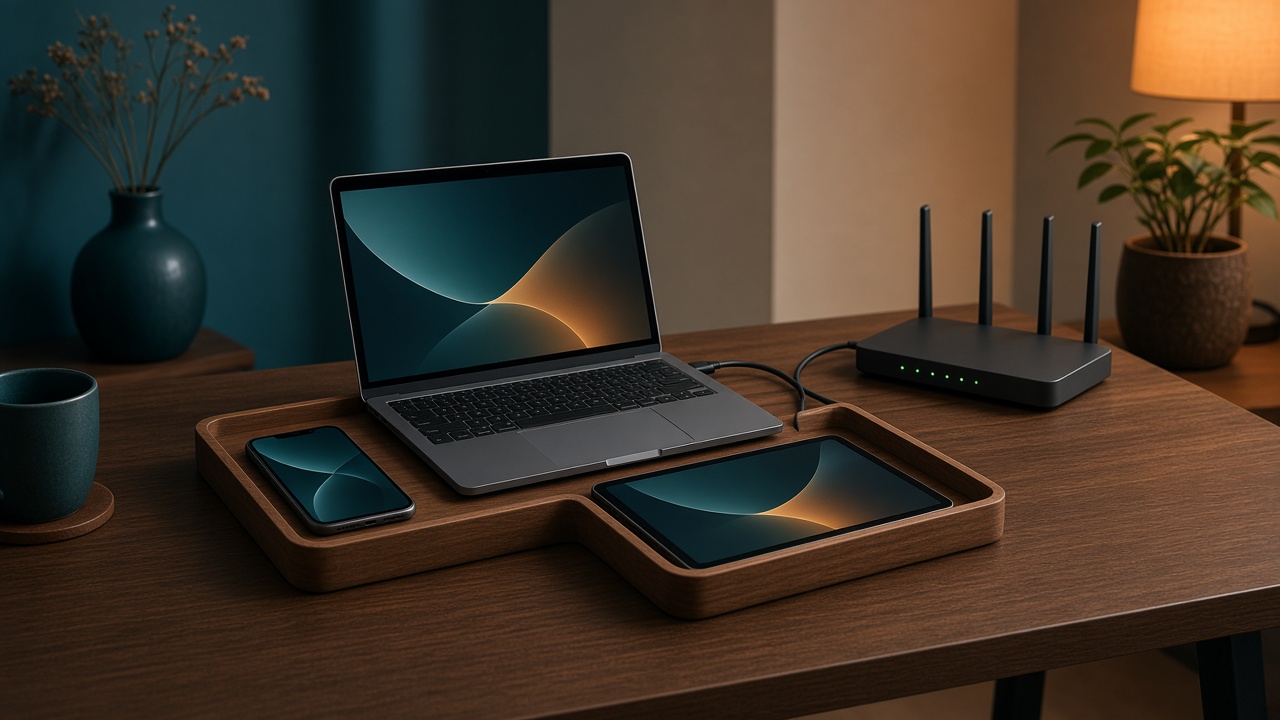
A home already has more than one screen. Phones, a television, a laptop and sometimes a console share a single internet account. That is normal. The new question is whether a participation programme should sit on one of those devices, or on a spare one in the corner. More devices are not more money. They are more ways to use the same road, and more ways to get in each other’s way. Read the next sections as a way to name speed, data and spare capacity in the same ordinary language you would use at the kitchen table. The useful result is knowing what can sit unused on a line you already pay for, and what must stay free for calls, school and the evening, before anyone mentions a reward. This guide is for adults aged 18 and over. It says when an extra device can make sense, and when it is a bad idea. The NEST is planned for 2026 and is not described as software on every screen. Rewards are variable and not guaranteed. Nothing here is financial, tax or legal advice, and nothing tells you to buy a machine. If a nearby sentence promises a fixed amount, a phone app that MetaEdge has not documented, or a household product you can install in every country today, it is not this explanation. Adults can wait, ask the provider, and leave the software off until the offer matches the words on the page.
One home, many screens
The account is the plan you pay the provider for. The devices are the things that use it. They are not the same object. A phone does not have its own contract just because it has its own screen. Bandwidth, the room on the line, is shared every evening already. Speed is how fast a task feels when that room is busy or free. If you add software, you add another ask on the same account. You do not open a second road.
Watch a normal evening before you imagine a layout. Who is on a call. Who is watching a film. Which machine updates itself at night. Those patterns tell you where the quiet hours are, if they exist. A spare laptop that is already on for work is a different case from a box you would switch on only for a programme. The first may add little power. The second adds power, noise and a new thing to forget. Write the pattern down. A brochure cannot see your sofa.
Wi-Fi, the wireless link inside the house, can be weak in a far room even when the plan is fine. Putting a device in that corner and then blaming the plan is a common mix-up. If a corner is already bad for a film, it is a bad place to judge anything else. Fix placement first. The contract still governs the whole account, whichever room the device sits in. A later check of the provider terms is not optional just because the hardware is yours.
An account is not a pile of rewards
Some offers talk as if each device were a separate earner. That picture skips demand. A customer either needs capacity in your area or does not. Two devices on one home line do not create two customers. They share one address on the network, one cap if you have one, and one contract. If there is no task, both devices can sit ready and still produce nothing. Readiness is not income. More screens share one road, one contract and one possible data cap.
MetaEdge describes The NEST as a planned opt-in layer for 2026, on a supported device, for eligible adults. It does not describe a requirement to install on every phone in the house. Eligible means the rules allow you, including age and country. Supported means the device is one the software is built for, not every gadget you own. Dates and countries can change. Anyone selling a bundle of devices so that “each one pays” is ahead of the plan and against the idea of a variable reward.
The enterprise platform is the part described as operating since 2023. Organisations can be customers without a household installing anything. Your account at home is not that business. Keeping the two apart stops a shopping trip. You do not need a second computer to understand the subject. You need the contract, a sense of your busy hours, and the freedom to use one device or none. The NEST is a plan for 2026, not a reason to fill a shelf this year.
When one extra device can make sense
An extra device can make sense when three things are already true. An adult has read the provider contract and the use is allowed. The plan is not sitting on a data cap you need for the household. And there is a machine that can run at quiet hours without stealing the evening from calls, school or a film. In that narrow case, a spare device can keep the software off the laptop you use for work. The separation is about comfort and control, not about doubling a payout.
The device should be one an adult can pause. Pause means participation stops without cancelling the internet account. If the off switch is unclear, the device is not a good home for the software, however spare it looks. Power matters too. A machine left on only for this purpose adds electricity. The guide on the net result refuses a sample figure because your tariff is yours. Add the device to the ledger before you add it to the corner. Pause must be possible, or the layout is not ready.
Quiet hours should be agreed, not discovered. If the house is empty on weekdays, a spare device then is a different proposition from a device running through dinner. Agree the window in plain words. Evenings are for the household. Optional software is off, or it is somewhere that does not touch the television and the call. One sentence on a note is enough. It is a household rule, not a technical design. A spare device is about comfort, not about a second income.
When it does not make sense
It does not make sense to buy hardware to chase a reward that is not guaranteed and may be zero. The purchase is a cost you pay for certain. The reward is a maybe. That imbalance is the same pattern as paying in order to get paid. Walk away from anyone who says the machines will cover themselves. They cannot know your demand, your power price, or your contract. This site will not invent the numbers that would make the purchase look safe.
It does not make sense to put software on a child’s device, or to let a teenager install an app “so the Wi-Fi earns”. Participation, if it is ever offered, is for adults aged 18 and over. A child does not sign the provider contract and does not pay the bill. A phone that is needed for school should not carry an experiment. If an offer recruits minors, that targeting is a warning, whatever the logo. Close it and talk in the house.
It does not make sense when the line is already tight, the cap is close, or the contract is unclear. More devices make those problems larger, not smaller. They add asks on a road that is already full, or they spend an allowance you wanted for yourselves. Read the guide on whether sharing slows the internet, and the one on the contract, before you add a box. A sensible layout cannot repair a forbidden use or a crowded evening. Say no and keep the screens you already understand.
Speed, the contract, and who decides
Every device shares the width. Software on one of them can still be felt on the others if the gaps are small. Test that only if a real product exists, you are allowed to try it, and you can pause. Pause, watch the hour you care about, and write what you saw. One evening is not science, but it is better than a stranger’s chart. If you cannot tell, leave it off. Uncertainty is a reason to stop, not a reason to add a second device.
The contract is about the account, not about the brand of the laptop. A home plan that limits resale or business-like use applies to traffic from every device on that plan. Ask the provider if the clause is silent. Silence is not a yes. Do not give anyone your provider password so they can “set up the devices”. You can read, and you can plug in a machine yourself. A password request is a warning pattern described in the guide on scams.
If more than one adult shares the bill, more than one adult should agree. The person who wants the software may not be the person who notices a slower film or a higher power bill. Put the decision where the costs land. A household can choose one spare device, the main computer, or nothing. Nothing is a complete choice. The next internet, in the sense of unused room offered on purpose, does not require every home to fill a shelf.
A sensible household rule
Try this rule, and change the hours to fit your life. One adult is responsible. One device, if any, and only a supported one. Busy hours stay clear. The software can be paused without a debate. No new purchases. No one under 18 installs or hosts it. The provider contract has been read, or a written answer is in the drawer. If any line of the rule fails, the device stays ordinary. A rule you cannot enforce is not a rule. It is a wish.
Rewards, if a programme later offers them, do not rewrite the rule. They are variable. They can be small. They can be nothing for a long stretch. Company materials mention that a reward might use tokens or a digital dollar called USDT, depending on final terms and local law. A token’s price can move. That is not a reason to add screens. The NEST remains a 2026 plan. Treating it as a reason to rewire the house this year is how calm reading turns into a shop.
You can stop at one account and the screens you already have. That is the setup most homes should keep until the documents, the country list and the contract answers exist. This article is information for adults, not financial, tax or legal advice. If the evening is the worry, read whether sharing slows the line. If the paperwork is the worry, read what to check in the provider contract. Both sit beside this page, and both can end in a simple no.
Questions people ask
Does each device earn separately?
Do not assume that. Devices on one home account share one line, one contract and, if you have one, one data cap. Demand is not multiplied by screens. Rewards, if any, are variable and not guaranteed.
Should I buy a computer for this?
No. A purchase is a certain cost. A reward is a maybe and can be zero. The NEST is planned for 2026 and is not a reason to fill a room with machines.
Can it run on a child’s phone?
No. This subject is for adults aged 18 and over. A school phone and a child’s device should stay out of it. Offers aimed at minors are a warning.
Will several devices slow the house?
They share the same road, so they can. A spare device in quiet hours may be less noticeable than software on the laptop you are using. You should be able to pause and see. This is not a promise of invisibility.
Who agrees?
Every adult who shares the bill. One person should be able to pause the software. The provider contract still covers the whole account. This page is not legal or financial advice.